
-
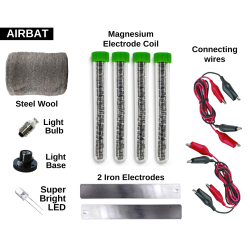 AIRBATAir/Saltwater Battery Kit$27.50
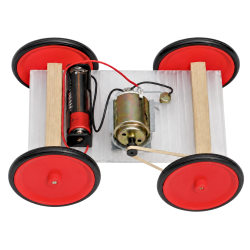 CAR_ELECElectric Car Kit$25 - $1500
 CAR_PROPAir Motor Car Kit (Car Propeller Kit)$15 - $950
 FOCAN-BOXPhysics Electric Circuit Learning Starter Kit Box$50
 KITEMElectromagnet Science Kits, Basic$15 - $900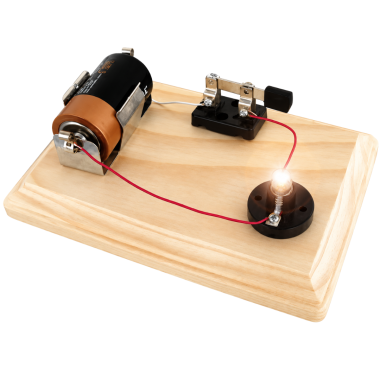
Simple Electric Circuit
Light up bulb with essential circuit materials.SKU: KITSECSimple Electric Circuit
This battery-powered educational kit demonstrates a series circuit by routing current from a dry-cell source through a switch and lamp load. The assembled setup shows the difference between open and closed circuits, supports conductor and insulator testing, and provides a physical model for observing electrical energy conversion.
Product Specifications
Circuit Type Series circuit with battery, switch, and light bulb Functionality Can light up a light bulb Power Source One D size battery required; battery not included Battery Holder One holder for D size battery Light Bulbs 2 bulbs, 1.2 V each Lamp Holder 1 lamp holder Switch 1 simple switch, known as a knife switch Base Wooden base or wooden board for mounting the circuit Wire Insulated solid copper wire, gage 22 Mounting Hardware Screws used to mount the switch and lamp holder Required Tools Screwdriver, scissors for cutting wire and removing insulation, and adult assistance when required Assembly Method Mount the battery holder, switch, and lamp holder to the board; loosen contact screws; strip 1/2 inch insulation from wire ends; connect the battery holder to the lamp holder, the lamp holder to the switch, and the switch to the battery holder Circuit Test Insert the battery, screw a light bulb into the lamp holder, and close the switch; if the bulb does not light, check contacts, battery, and bulb Operating States Open circuit or open switch: light off; closed circuit or closed switch: light on Instructions Instructions Online Additional Project Materials Thermometer, clock with seconds display, black electrical tape, color paper for a lamp shade, and test objects such as coins, paper clips, nails, glass, plastic, stone, wood, pencil lead, rubber, safety pins, gold, silver, and aluminum foil
Applications and Benefits:
- Construct a basic electric circuit that lights a bulb.
- Learn the basic concepts of electricity and electrical circuits.
- Build a battery-powered light circuit controlled by a switch.
- Observe how a power source, resistor, and switch operate in series.
- Compare open-circuit and closed-circuit behavior.
- Use the assembled circuit as a science project, educational activity, or technology project.
- Add a paper lamp shade and use the assembled circuit as a night light activity.
- Investigate whether electrical energy can be converted to heat by measuring bulb temperature every 60 seconds.
- Identify conductors and insulators by placing materials between the poles of the open switch.
- Test metals and non-metals such as coins, nails, paper clips, pencil lead, rubber, wood, plastics, glass, and aluminum foil.
- Record conductivity results in a material and conductivity data table.
- Support discussion of why birds can sit on high-voltage electrical cables when current does not pass through their bodies to ground or another wire.
Caution:
This product contains small parts that may pose a choking hazard for young children. Adult supervision is recommended during use and required for assembly steps that involve tools. A D size dry cell is usually about 1.5 V; materials that insulate at 1.5 V may conduct at higher voltages, and even air can conduct at high voltage. Do not experiment with higher voltages. For very high voltages such as 6000 V, stay at least 5 feet away from high-voltage cables. Do not use flame to remove wire insulation because it is dangerous and will blacken the wire ends. No electrical contact will be made if insulation is not removed from the wire ends. Handle battery holder clips with care because excess force may detach them.
- Availability: In Stock
- Model: KITSEC
-
Brand:

Write Review
- 12 V
- 15 V
- AWG 22
- base
- Basic Electric Circuit Kit
- batteries
- battery
- battery holder
- board
- bulb
- bulbs
- circuit
- circuit kit
- circuits
- conductor
- conductors
- copper
- D battery
- DC
- dry cell
- electric
- electric kit
- electricity
- Electricity Discovery Kit
- Electricity Experiment Kit
- Electricity Learning Set
- Electricity Science Kit
- gage 22
- gauge 22
- insulator
- insulators
- kit
- KIT SEC
- KIT-SEC
- kits
- KITSEC
- knife switch
- lamp
- lamp holder
- lamps
- light
- science kit
- simple
- Simple Electric Circuit
- switch
- switches
- wire
- wires
-
 Air/Saltwater Battery Kit
-
 Advanced Air Saltwater Battery Kit
-
 Buzz Wire Kit, 36" Conductor
-
 Electric Car Kit
-
 Air Motor Car Kit (Car Propeller Kit)
-
 Pulley Motor Car Kit
-
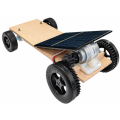 Solar Car Kit
-
 Model Car Kit, 4 Wheel Drive
-
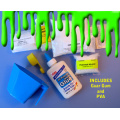 Slime Science Kit (Polymer)
-
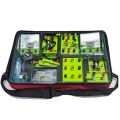 Physics Electric Circuit Learning Starter Kit Bag
-
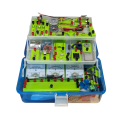 Physics Electric Circuit Learning Starter Kit Box
-
 Bacteria Growth Science Kit
-
 Battery Life Test Kit
-
 Car Boat Hybrid Motor Kit
-
 Electricity & Conductivity
-
 Electromagnet Science Kits, Basic
-
 Electromagnet Science Kits, Advanced


